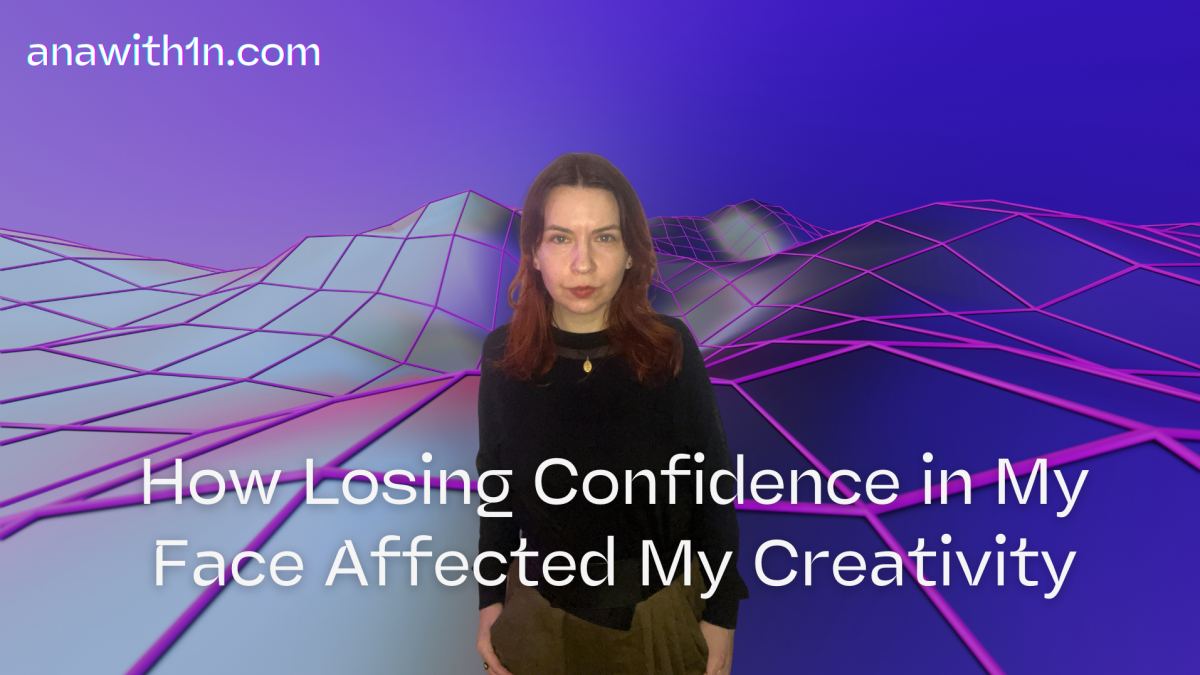
How Losing Confidence in My Face Affected My Creativity
 Ana with 1 N
How chronic stress showed up in my face and made me look older at 25 than at 39
When an Old Photo Made Me Stop
A few days ago, someone from my past sent me a photo of myself from 2011. I was 25 years old at the time.
I didn’t react immediately. Instead, I found myself standing still, looking at it for longer than I expected, trying to understand what exactly was unsettling me. It wasn’t nostalgia, and it wasn’t sadness either. The feeling was quieter, more subtle, almost difficult to name.
At some point, a thought surfaced that surprised me by its clarity: why do I look older there than I do now, at 39?
At first, it felt almost wrong to admit that to myself. We’re conditioned to believe that age alone dictates how a face changes, that time moves in one direction and leaves visible marks as it goes. Yet the longer I looked at that image, the clearer it became that what I was seeing had very little to do with age itself.
At 25, I was younger, yes, but I was also far more tense, more insecure, and more exhausted than I am today. And my face was carrying all of it, most noticeably in my eyes and in my jaw.
That photo didn’t open a question about ageing.
It opened a question about stress, self-expression, and the quiet, gradual way losing confidence in my face had also muted my creativity.
Stress Isn’t Abstract, It Has a Face
We often talk about stress as something mental, almost theoretical, as if it exists only in our thoughts and nowhere else. But the body doesn’t work that way. And the face, in particular, has a way of revealing what we’ve learned to hide.
Facial muscles are deeply connected to the nervous system, which means that when life becomes about adapting, enduring, staying quiet, or staying strong, the face adapts too. Not in dramatic ways, and not overnight, but subtly and consistently, through patterns that settle in and become familiar.
Over time, there are two areas that tend to carry this weight first: the jaw and the eyes.
The Jaw and the Weight of What Was Never Said
The jaw is one of the body’s primary survival zones. It reacts quickly in situations where speaking feels unsafe, inconvenient, or emotionally costly, and it learns to stay on guard long after the moment has passed.
Unspoken words, swallowed reactions, and the habit of not taking up space all leave a physical imprint. Deep muscles of the jaw, including the pterygoids, contract under chronic stress. You don’t see them when you look in the mirror, but their effects slowly appear nonetheless: a heavier lower face, reduced softness, tension around the mouth, and an expression that looks guarded even when the body is supposedly at rest.
These changes are often labelled as ageing, yet they have very little to do with time itself.
They are the visible result of protection.
The Eyes and Permanent Alert Mode
The eyes tell a similar story. They are directly linked to the brain’s threat-response system, which means that when stress becomes constant, the muscles around the eyes and forehead rarely have the chance to fully let go.
At first, the change is subtle: a tired quality in the gaze, a loss of brightness that’s difficult to describe but immediately recognisable. And it happens even in young faces.
This is why two people of the same age can look strikingly different. One appears open and at ease, while the other looks alert, as if something might go wrong at any moment. The face reflects the state of the nervous system far more accurately than it reflects the number of years lived.
When Facial Tension Silenced My Creativity
For a long time, I didn’t connect this physical tension to my creative life. Only later did the link become obvious.
As my face stopped feeling safe to be seen, my creativity stopped feeling safe to be expressed. I avoided cameras, hesitated before sharing ideas, and softened my voice to the point of disappearing at times. It wasn’t that I lacked ideas; it was that expression itself had begun to feel risky.
A jaw that is always holding back doesn’t just restrict movement, it restricts voice. Eyes that never fully rest don’t simply look tired, they lose their spark.
My creativity didn’t disappear. It adapted. Like the rest of me, it shifted into survival mode.
What Changed When I Started Working With My Face
The shift didn’t come from affirmations or mindset work alone. It came from the body, and more specifically from learning how to release rather than fix.
As my jaw softened, my breath changed with it. As my eyes were allowed to rest and reopen without effort, something in my expression, and in my sense of presence, followed naturally. Circulation improved, the nervous system settled, and my face began to look lighter and more open.
The most surprising change, however, wasn’t aesthetic.
It was the return of creative flow.
When the body no longer feels the need to protect itself, expression becomes possible again.
The Realisation That Changed Everything
This is the part that surprised me most.
At 25, I looked older than I do now at 39, not because time reversed, but because tension released.
At 25, I was more tense, more insecure, and far more tired than I am today, and that ages a face far more effectively than fourteen years ever could. Today, my face is more relaxed, more open, brighter, and more confident, not because age disappeared, but because the weight I was carrying no longer lives there.
Why the Face Always Knows First
The face isn’t just aesthetic. It’s emotional, neurological, and deeply connected to creativity.
Where the body stays in protection, time appears first.
Where the body relaxes, youth returns.
Not because ageing stops, but because tension does.
The youth was never gone.
It was simply held.
If This Resonates
If you recognise yourself in any of this, you don’t need to change everything at once.
Glow Up Express is my free starting point, a gentle way to begin releasing facial tension and reconnecting with your face in just a few minutes a day.
And if you feel ready for something more personal, I also offer 1:1 sessions where we work together on facial tension, expression, and confidence in a way that’s tailored to you.
No pressure. No perfection.
Just a body that finally feels safe to be seen again.
Categories: : MemoryinMotion
Get Your Free Guide: Glow Up Express ✨
Discover small daily steps that bring big results.
In this free guide, you’ll learn simple Face Dance rituals to reduce tension, tone your face, and boost your natural confidence — in just a few minutes a day.